

Digital Invoicing in Pakistan | FBR & POS Guide
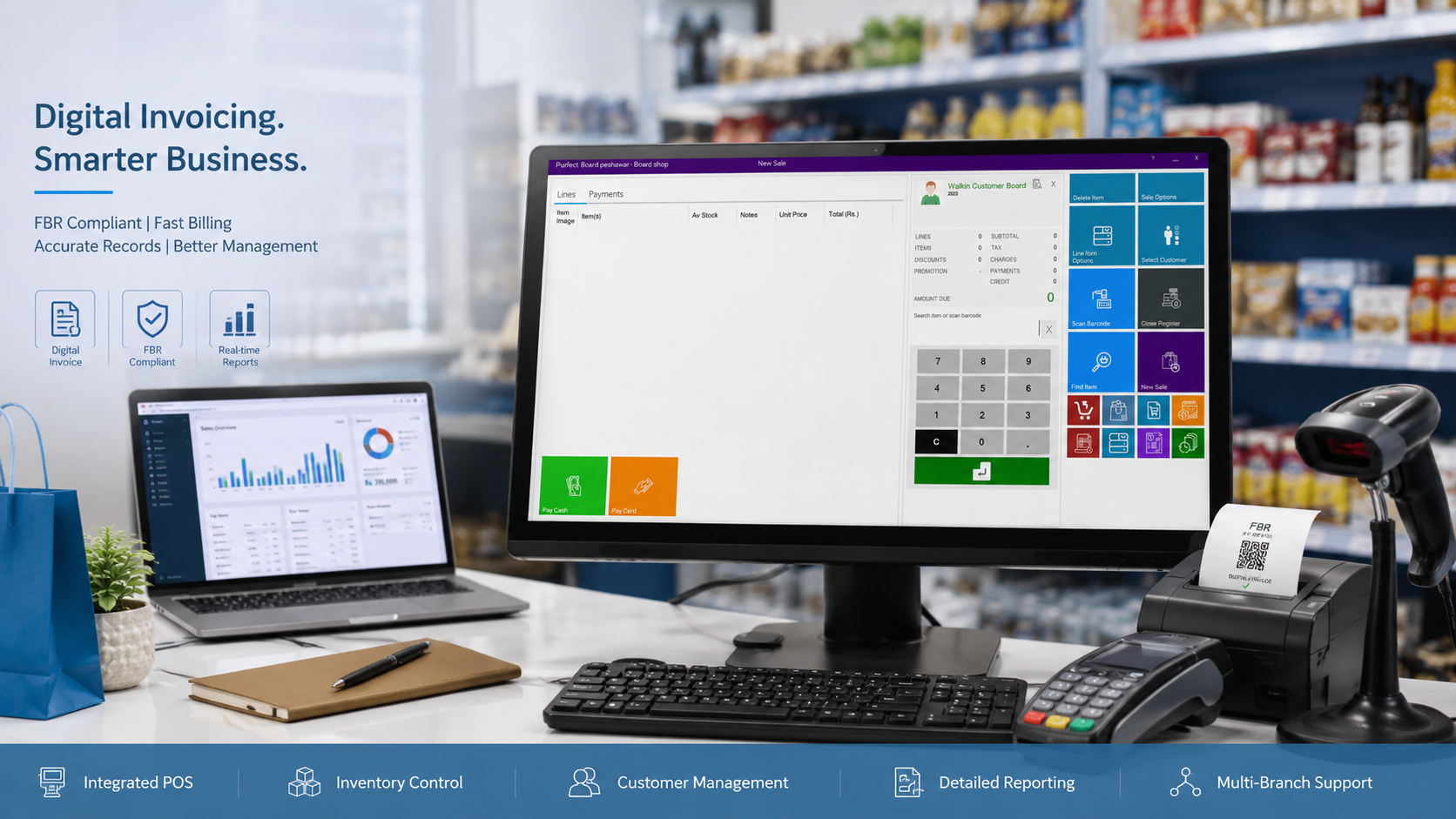
Digital Invoicing in Pakistan: A Complete Guide to FBR E-Invoicing & POS Integration
Introduction
Digital invoicing in Pakistan is reshaping how businesses handle billing, tax compliance, and record management. Moving away from traditional paper invoices, more businesses—from retailers and supermarkets to restaurants and e-commerce—are embracing digital invoicing solutions. This shift is driven by the Federal Board of Revenue’s (FBR) adoption of electronic invoicing frameworks and the rise of modern Point of Sale (POS) systems equipped with integrated invoicing capabilities. Digital invoicing not only enhances operational efficiency but also ensures compliance with tax regulations, making it increasingly important for Pakistani businesses.
What Is Digital Invoicing?
Digital invoicing, also referred to as electronic invoicing or e-invoicing, involves generating, transmitting, and storing invoices in a structured electronic format. Unlike scanned paper invoices or simple PDFs, a true digital invoice contains machine-readable data that facilitates automated processing and compliance.
Key distinctions include:
- Structured electronic invoice: A digitally created invoice with standardized data fields enabling automated processing.
- Scanned paper invoice: An image of a paper invoice without structured data, limiting automated use.
- PDF invoice: A digital document that often lacks structured data, making automated extraction difficult.
- Digitally generated invoice: Created within invoicing software to meet tax authority specifications for digital submission.
According to FBR guidelines, digital invoices must comply with their e-invoicing standards for authenticity and legal validity.
What Is FBR Digital Invoicing?
FBR digital invoicing is a regulatory framework requiring specific businesses to generate electronic invoices that comply with FBR’s technical and legal standards. These invoices are transmitted electronically to the FBR system, enabling real-time reconciliation and audit.
Invoices can be generated and transmitted through:
- POS software integrated with FBR e-invoicing protocols
- Enterprise Resource Planning (ERP) systems with invoicing modules
- Specialized digital invoice software approved or licensed by FBR
Licensed integrators may be involved to ensure secure, compliant communication between business systems and the FBR platform, depending on the scale and category of the business.
Who Needs Digital Invoicing in Pakistan?
FBR mandates digital invoicing primarily for large-scale taxpayers engaged in retail, wholesale, e-commerce, and multi-branch operations. Businesses such as supermarkets, distributors, wholesalers, and e-commerce sellers meeting specific turnover thresholds or sector criteria are required to comply.
It is essential to consult the latest FBR notifications or official websites for up-to-date information on the scope of digital invoicing obligations, as requirements evolve.
How Does Digital Invoicing Work With POS Software?
The digital invoicing process integrated with POS software typically follows this workflow:
Customer Transaction → POS Billing → Invoice Generation → Integration/Transmission → Digital Invoice → Customer Receipt → Record Keeping & Reporting
- A sale is initiated at the POS.
- The POS system captures transaction details and generates a digital invoice formatted per FBR standards.
- The invoice data is transmitted to FBR via integrated software or a licensed integrator.
- The system stores the digital invoice securely.
- The customer receives a printed or digital copy of the invoice.
- Businesses maintain records and generate reports for accounting and tax purposes.
The exact workflow and integration depend on the business’s category and applicable FBR mandates.
Digital Invoicing vs Traditional Invoicing
|
Feature |
Traditional Invoicing |
Digital Invoicing |
|
Billing speed |
Slower due to manual entry |
Faster with automation |
|
Manual errors |
Higher risk due to manual data handling |
Reduced errors with system validation |
|
Record keeping |
Paper-based, prone to loss |
Secure digital storage with easy retrieval |
|
Reporting |
Time-consuming manual reports |
Real-time, automated reports |
|
Invoice retrieval |
Difficult and slow |
Instant and digital |
|
Business scalability |
Limited by manual processes |
Easily scalable with software |
|
Integration |
Standalone, no direct tax authority link |
Integrated with FBR and accounting systems |
Benefits of Digital Invoicing
Digital invoicing provides multiple benefits to Pakistani businesses:
- Faster billing processes reduce customer wait times.
- Less manual data entry lowers human errors and operational costs.
- Improved invoice record accuracy and security.
- Quick retrieval of invoices aids audits and customer service.
- Enhanced sales and financial reporting with real-time data.
- Simplified tax compliance through automated FBR submission.
- Seamless integration with POS and accounting software.
- Improved customer satisfaction through accurate, timely invoices.
- Supports business growth with scalable digital systems.
Why Integrate Digital Invoicing With POS?
Integrating digital invoicing with POS software connects several critical business functions:
- Sales and invoicing happen simultaneously.
- Inventory levels update automatically.
- Accounting records are maintained without duplicate entry.
- Customer data is centralized for better service.
- Comprehensive reporting provides operational transparency.
This integration optimizes workflows, reduces errors, and ensures compliance with FBR digital invoicing requirements.
How to Choose Digital Invoicing Software in Pakistan
When selecting software, consider:
- Compliance with FBR digital invoicing standards.
- Compatibility with licensed integrators if required.
- POS integration for unified billing and inventory management.
- Strong invoice management system features.
- Inventory and accounting integration capabilities.
- Support for multi-branch management.
- Comprehensive reporting tools.
- Robust security measures.
- Reliable technical support.
- Scalability to grow with your business.
Choosing software that aligns with your operational needs and legal requirements is essential.
Digital Invoicing for Different Businesses
- Retail stores: Speedy billing and stock updates.
- Supermarkets: Handle high-volume transactions efficiently.
- Restaurants: Quick bill generation with tax compliance.
- Pharmacies: Accurate digital records for inventory and sales.
- Boutiques: Personalized invoicing and customer management.
- Electronics stores: Detailed invoices for warranties and returns.
- Wholesalers & Distributors: Bulk invoicing with FBR integration.
- E-commerce: Online invoicing system Pakistan compliant with FBR.
- Multi-branch: Centralized control over multiple outlets.
Common Digital Invoicing Challenges
Businesses may encounter:
- Transitioning from manual to automated billing.
- Training employees in new systems.
- Limitations in current POS solutions.
- Integration complexities with existing software.
- Dependence on stable internet connectivity.
- Migrating historic data to new systems.
- Keeping up with evolving FBR requirements.
- Selecting the right compliant software.
Effective planning and support can address these challenges.
How Pointofsale.pk Can Help
Pointofsale.pk offers a comprehensive platform designed for Pakistani businesses, featuring:
- Efficient POS billing for faster transactions.
- Fully compliant digital invoicing aligned with FBR standards.
- Seamless FBR integration automating invoice submission.
- Robust inventory management with real-time updates.
- Integrated accounting modules.
- CRM tools to manage customer relations.
- Detailed reporting for business insights.
- Support for multi-branch management.
- Business automation reduces manual effort.
Looking to simplify digital invoicing and business management? Explore Pointofsale.pk and find a POS solution suited to your business requirements.
Frequently Asked Questions
- What is digital invoicing in Pakistan?
Digital invoicing is generating and transmitting invoices electronically in formats compliant with FBR regulations. - Is digital invoicing mandatory in Pakistan?
FBR requires it for certain businesses based on turnover and sector; always check current official guidelines. - What is FBR digital invoicing?
A system for electronic invoice creation and submission to FBR for tax compliance. - What is the difference between a digital invoice and a scanned invoice?
A digital invoice is structured for automated processing; a scanned invoice is an unstructured image of a paper invoice. - Can POS software integrate with FBR digital invoicing?
Yes, many POS solutions in Pakistan support FBR integration for automated invoicing. - Does a business need a licensed integrator?
Depending on FBR rules and software, a licensed integrator may be required for secure data transmission. - What information is included in an electronic invoice?
Buyer/seller details, invoice number, date, item details, prices, taxes, and total amount. - How can a business start using digital invoicing?
By adopting compliant POS or invoicing software with FBR integration and training staff accordingly.
Conclusion
Digital invoicing is vital for modern Pakistani businesses to improve billing efficiency, ensure tax compliance, and enhance operational visibility. Integrating digital invoicing with POS software streamlines workflows and supports business growth. Pointofsale.pk provides tailored solutions to meet FBR requirements and help businesses manage invoices, inventory, and reporting with ease. Embrace digital invoicing today to future-proof your business.
Author Details

Syed Hussain Raza
Syed Hussain Raza is a Customer Succession and Operations Lead who drives revenue growth by connecting smart sales strategies with smooth operational workflows to eliminate bottlenecks and maximize client retention.
Related Posts

10 Sep,2026
Restaurant Management: Improve Efficiency, Sales & Customer Experience
Restaurant Management: How Smart Technology Can Improve Efficiency, Sales and Customer Experience
Running a restaurant successfully...
3 Sep,2026