

SRB Compliance: Complete Guide for Sindh Businesses
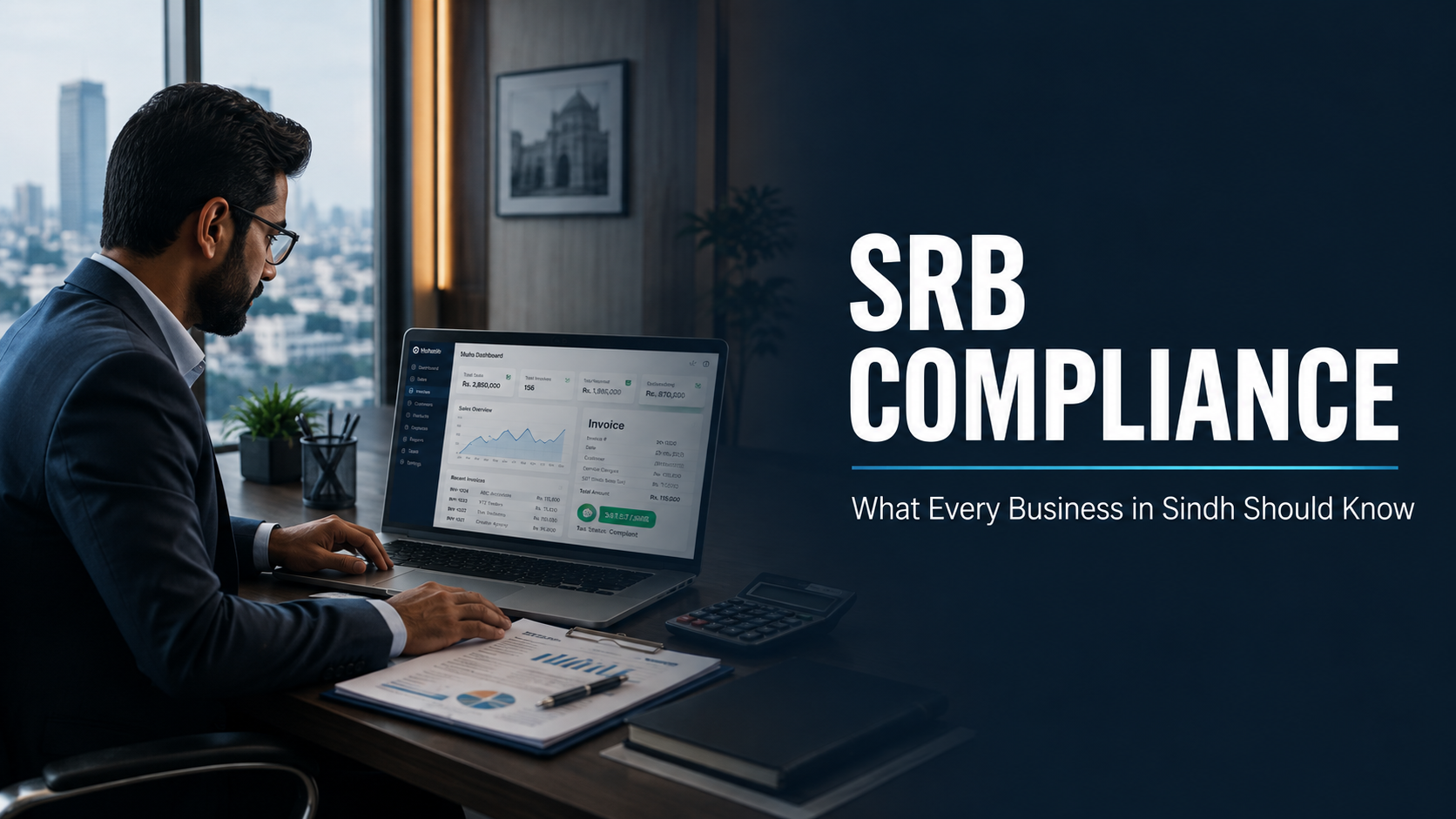
What Is SRB Compliance? A Complete Guide for Businesses in Sindh
Introduction
Running a business involves more than selling products or providing services. Businesses operating in Sindh may also have tax registration, invoices, record-keeping, return-filing, and payment responsibilities. For service providers falling within the Sindh Sales Tax framework, understanding SRB compliance is an important part of managing these obligations properly.
SRB stands for Sindh Revenue Board, the provincial authority responsible for administering Sindh Sales Tax on Services. SRB states that taxable services are listed in the Second Schedule to the Sindh Sales Tax on Services Act, 2011, and encourages businesses whose activities fall within the taxable-services framework to register and regularly pay their sales tax.
For business owners, SRB compliance essentially means following the applicable rules for registration, tax calculation, invoicing, record keeping, return filing, and payment.
This guide explains SRB compliance in straightforward terms and explores how business management software can help businesses organize their tax-related records and workflows.
What Is SRB?
The Sindh Revenue Board (SRB) is the provincial revenue authority responsible for the administration of Sindh sales tax on services.
The legal framework is primarily established through the Sindh Sales Tax on Services Act, 2011, together with related rules, notifications, and special procedures. SRB provides electronic services for registration, tax payment, and return filing.
The important point for businesses is that SRB primarily concerns services, rather than being a general replacement for federal taxation administered by the Federal Board of Revenue (FBR).
SRB publishes a list of taxable services and applicable rates. Its current website states that the general rate of Sindh sales tax on services is 15%, while certain services may have different, reduced, concessionary, or exempt treatment. Telecommunications, for example, are subject to a different rate. Therefore, businesses should always verify the rate applicable to their service rather than assuming that one rate applies to everything.
What Is SRB Compliance?
SRB compliance means fulfilling the applicable legal and administrative requirements imposed under the Sindh Sales Tax on Services framework.
Depending on the nature of a business and the services it provides, this can involve:
- Determining whether the business provides a taxable service
- Registering with SRB where required
- Calculating the applicable sales tax
- Issuing appropriate invoices
- Maintaining financial and transaction records
- Filing sales tax returns
- Paying the tax within the applicable deadlines
- Maintaining support documentation
- Responding to applicable audits or assessments
SRB itself describes electronic registration, enrolment, payment, and return-filing processes as part of its tax administration system.
In simple terms:
Provide taxable service → Calculate applicable tax → Issue invoice → Record transaction → File return → Pay tax
The exact process can vary according to the service, taxpayer status, applicable special procedures, and current legislation.
Who Needs SRB Compliance?
Not every business automatically has the same SRB obligations.
The first question is:
Does the business provide a service that falls within the taxable-services framework applicable in Sindh?
SRB publishes its tax service list and advises Sindh-based taxpayers to review it and register if their economic activity falls within its scope.
Potentially affected businesses can include various service providers operating in sectors such as:
- Restaurants and hospitality
- Advertising
- Consultancy and professional services
- Property-related services
- Transportation-related services
- Beauty and personal-care services
- Financial services
- IT and business support services
- Other services specifically covered by the applicable tariff and rules
However, the nature of the service, place of provision, applicable tariff heading, exemptions, special procedures, and other legal conditions matter. A business should therefore not determine its SRB obligations simply based on its industry name.
Key SRB Compliance Requirements
- SRB Registration
Where registration is required, a qualifying taxpayer must complete the applicable SRB registration process.
SRB provides an electronic registration facility and publishes a dedicated registration user manual for taxpayers.
Before registering, businesses should determine whether their services fall within the applicable taxable services provisions.
- Correct Tax Calculation
Once a service is identified as taxable, the business needs to determine the appropriate tax rate and calculation method.
This is particularly important because the rate is not necessarily identical for every service. SRB's official taxable services page currently identifies 15% as the general rate while noting exceptions and concessionary or reduced rates.
Businesses should therefore verify:
- Applicable tariff heading
- Applicable tax rate
- Exemptions or concessions
- Special procedures
- Place-of-provision rules
- Input tax or other applicable adjustments
- SRB Tax Invoice
Proper invoicing is an important part of maintaining reliable tax records.
An invoice should contain the information required under the applicable SRB rules and should accurately represent:
- Service provider
- Customer
- Description of service
- Service value
- Applicable sales tax
- Total amount
- Relevant registration/tax information where required
For businesses using digital systems, automated invoices can significantly reduce manual calculation and documentation errors.
- Record Keeping
Businesses should maintain appropriate records supporting their sales, purchases, tax calculations, invoices, and returns.
Good record keeping allows a business to:
- Track taxable transactions
- Reconcile sales with invoices
- Review of tax calculations
- Prepare returns
- Responding to queries
- Support audit requirements
- Identify discrepancies
This is one area where accounting, POS, and ERP systems can provide significant practical value.
- SRB Return Filing
Registered taxpayers required to file returns must follow the applicable filing procedure.
SRB provides electronic return-filing facilities, and its rules provide for electronic filing through the SRB portal.
Businesses should monitor their applicable tax periods and filing deadlines carefully because late filing can create compliance issues.
SRB also provides user manuals covering registration, payment, and return filing.
- Tax Payment
After determining the applicable tax liability, the taxpayer must pay the amount according to the relevant rules and deadlines.
The specific payment procedure and due date can depend on the applicable provisions or special procedure. Businesses should therefore verify the current SRB requirements rather than relying on outdated schedules.
- Documentation and Audit Readiness
Tax compliance isn't only about filing a return.
Businesses should maintain supporting documentation that allows transactions and tax calculations to be explained and verified.
A well-organized digital record system can make it easier to retrieve:
- Sales invoices
- Customer records
- Transaction histories
- Tax calculations
- Payment records
- Reports
- Relevant supporting documents
SRB Compliance Example
Consider a hypothetical service provider in Sindh that provides a taxable service worth Rs. 100,000.
If the service is subject to the general 15% Sindh sales tax rate, the calculation would be:
|
Description |
Amount |
|
Service value |
Rs. 100,000 |
|
Sales tax 15% |
Rs. 15,000 |
|
Total invoice |
Rs. 115,000 |
SRB currently identifies 15% as the general rate for Sindh sales tax on services, but this example is illustrative only. Actual rates can vary depending on the service and applicable provisions, including reduced rates, exemptions, or special procedures.
For example, SRB's official information shows that certain restaurant services have specific rules and rates, demonstrating why businesses should check the applicable service category instead of applying a standard rate automatically.
SRB vs FBR Compliance
One of the most common sources of confusion for Pakistani businesses is the difference between SRB and FBR.
|
Aspect |
SRB |
FBR |
|
Full name |
Sindh Revenue Board |
Federal Board of Revenue |
|
Level |
Provincial |
Federal |
|
Key area relevant here |
Sales Tax on Services in Sindh |
Federal taxes and federal sales-tax matters |
|
Geographic focus |
Sindh |
Pakistan |
|
Main legislation |
Sindh Sales Tax on Services framework |
Federal tax laws |
|
Example obligation |
Sindh sales tax on applicable services |
Income tax, federal sales tax and other federal obligations |
A business can potentially have both federal and provincial tax obligations, depending on its activities.
Therefore, SRB compliance should not be viewed as a substitute for FBR compliance.
Common SRB Compliance Mistakes
- Applying the Wrong Tax Rate
Using a generic rate without checking the applicable service category can result in incorrect tax calculations.
- Missing or Incorrect Invoices
Incomplete invoices can make it difficult to establish what service was provided and how the tax was calculated.
- Late Return Filing
Missing filing deadlines can create unnecessary compliance problems and potentially lead to penalties or other consequences under applicable law.
- Poor Record Keeping
Businesses relying entirely on paper records or scattered spreadsheets can struggle to reconcile transactions and prepare accurate returns.
- Misidentifying Taxable Services
A business may incorrectly assume that its services are outside the SRB framework without checking the relevant tariff classification and current rules.
- Using Outdated Tax Information
Tax rates, procedures, exemptions, and special rules can change through finance acts, notifications, and amendments. SRB's official Acts and Rules page currently lists the Sindh Finance Act 2026, effective from July 1, 2026, along with updated legislation and rules.
For this reason, businesses should verify current requirements before making tax decisions.
How Business Software Can Help With SRB Compliance
Technology cannot replace professional tax advice or a taxpayer's legal responsibility, but a well-designed accounting, POS, or ERP system can make compliance-related processes more organized.
Sales Records
Software can maintain centralized records of sales and service transactions instead of relying on manually maintained registers.
Tax Calculations
Configured tax rules can help automate calculations and reduce repetitive manual work.
Invoicing
Businesses can generate standardized invoices containing relevant transaction and tax information.
Transaction History
Digital systems allow businesses to search and review previous transactions quickly.
Reports
Management can generate sales, tax, customer, and financial reports for review and reconciliation.
Record Management
Centralized digital records make it easier to retrieve information when preparing returns or reviewing transactions.
Reduced Manual Errors
Automation can reduce common data-entry and calculation mistakes, particularly for businesses processing many transactions.
However, software should be configured according to the current applicable SRB rules, and businesses should periodically review their tax settings.
How Muhasib Can Support Businesses
Muhasib by Websol Technologies (Pvt.) Ltd. can be positioned as a business management solution that helps organizations maintain organized sales, finance, and transaction records.
For businesses dealing with tax-related workflows, a business management system can help bring together important information such as:
- Sales transactions
- Customer information
- Invoices
- Tax-related calculations
- Transaction history
- Financial reports
- Business records
The value of software is particularly apparent when a business moves from manual registers and spreadsheets toward centralized digital record management.
Muhasib can therefore help businesses organize their records and support compliance-related workflows, while the business remains responsible for ensuring that its configuration, tax treatment, filings, and payments comply with current SRB requirements.
This distinction is important: software can support compliance; it does not itself guarantee legal or tax compliance.
Frequently Asked Questions
What does SRB stand for?
SRB stands for Sindh Revenue Board, the provincial authority responsible for administering Sindh sales tax on services.
What is SRB compliance?
SRB compliance means fulfilling the applicable requirements relating to Sindh sales tax on services, including registration where required, correct tax calculation, invoicing, record keeping, return filing, and payment.
Who needs to register with SRB?
Businesses and service providers whose activities fall within the applicable taxable services framework may be required to register. SRB publishes the relevant list of taxable services.
What is Sindh Sales Tax on Services?
It is a provincial sales tax imposed on services falling within the scope of Sindh's sales-tax-on-services legislation.
What is the difference between SRB and FBR?
SRB administers relevant provincial taxation in Sindh, particularly sales tax on services, while FBR is the federal revenue authority responsible for federal taxes and related matters.
How often are SRB returns filed?
The filing period and procedure applicable depend on the taxpayer and relevant rules. SRB provides electronic filing facilities, and its rules provide for electronic filing of sales tax returns. Businesses should check their current filing requirements directly with SRB.
Can accounting software help with SRB compliance?
Yes. Accounting, POS, and ERP software can help organize transactions, invoices, tax calculations, reports, and records. However, software does not replace professional tax advice or the taxpayer's responsibility to follow current SRB requirements.
Conclusion
SRB compliance is an important responsibility for businesses providing taxable services in Sindh. It involves more than simply paying sales tax. Businesses may need to determine whether their services are taxable, complete registration where required, calculate the correct tax, issue appropriate invoices, maintain records, file returns, and make payments according to applicable rules.
The biggest challenge for many businesses is maintaining accurate information consistently. Digital business management systems can help by centralizing transactions, automating routine calculations, organizing invoices, and making reports easier to access.
For businesses using solutions such as Muhasib, the goal should be to turn tax-related record management from a fragmented manual process into a more organized digital workflow.
Ultimately, effective SRB compliance comes from combining accurate records, appropriate software, timely reporting, and up-to-date knowledge of applicable tax rules.
Author Details

Syed Hussain Raza
Syed Hussain Raza is a Customer Succession and Operations Lead who drives revenue growth by connecting smart sales strategies with smooth operational workflows to eliminate bottlenecks and maximize client retention.
Related Posts

10 Sep,2026
Restaurant Management: Improve Efficiency, Sales & Customer Experience
Restaurant Management: How Smart Technology Can Improve Efficiency, Sales and Customer Experience
Running a restaurant successfully...
3 Sep,2026